Reading Plant Architecture: A Small-Practice Guide to Seeing Structure in the Garden
Problem
We walk past the same plants for seasons and still feel surprised by them. Flowers and color get the attention; form and structure slip by. Missing the architecture of a plant—how it branches, how leaves stack, how mass and void balance—means missed opportunities: better pruning, clearer winter interest, and stronger garden compositions. The problem isn’t lack of information; it’s lack of a simple way to notice structure in the moment.
Principles
The following principles reduce the many details of a plant to a few repeatable cues. They are practical: use them in five minutes while standing in the garden.
1. Silhouette and Negative Space
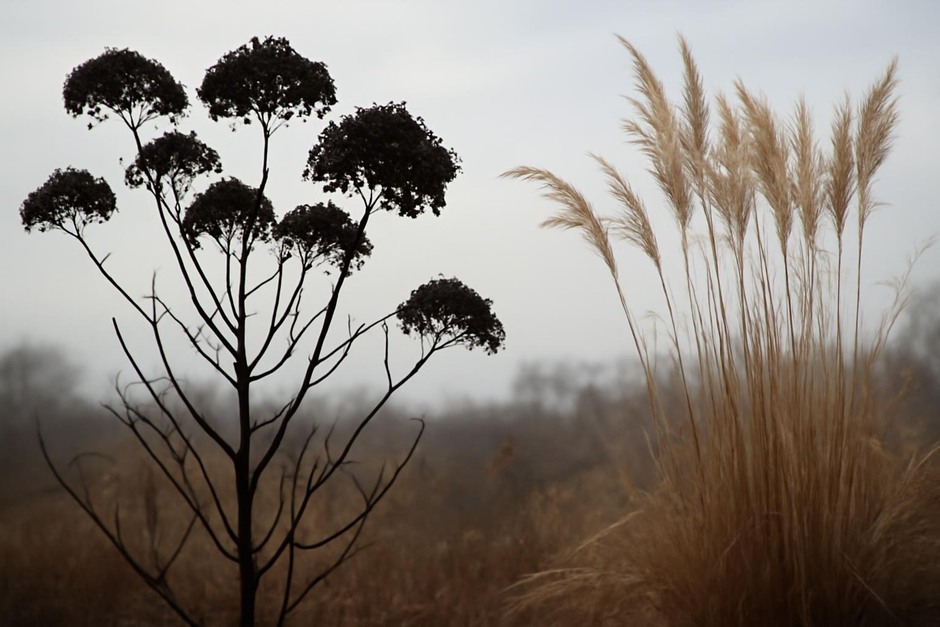
Step back and read the plant as a single shape against the sky or a fence. A silhouette reveals the outer boundary and the larger voids within the plant. Does the outline read as one mass, a tiered shape, or a loose, open form? Negative spaces—the holes and gaps—are as important as the stems themselves for visual rhythm and light penetration.
2. Branching Rules
Every species has characteristic branching: strong central leaders, multi-stem clumps, or repeated forked branches. Note branch angles and where thick branches give way to thinner ones. Broad, horizontal branches suggest a spreading habit; narrow, steep angles suggest upright growth. These rules hint at where a plant will need thinning or can be left alone to develop natural form.
3. Leaf Arrangement and Rhythm
Leaves determine surface rhythm. Are they opposite, alternate, spiraled, or clustered? Small, regularly spaced leaves create a fine texture; large, few leaves make bolder, simpler planes. Leaf rhythm affects shadow, translucence, and the plant’s apparent density.
4. Seasonal Persistence
Consider what elements persist through the seasons: seedheads, branch tips, evergreen foliage. These anchors give a plant compositional value when color and flowers are gone. Note where persistent elements sit in the silhouette—do they mark the top, the inner structure, or the edge?
Examples
Short, specific observations you can try in an ordinary garden.
Hydrangea (spent flowers and winter silhouette)
- Problem to notice: In winter hydrangea heads can obscure branching, making pruning risky.
- What to look for: Break the plant down into major stems. Identify the main older wood (thicker, darker) and the newer shoots (paler, more flexible).
- Why it matters: Removing a few old stems at the base opens the silhouette and lets the plant make stronger new shoots in spring.
Ornamental Grass (seedhead rhythm)
- Problem to notice: Seedheads create movement and vertical rhythm; they can either read as a diffuse veil or a clear vertical counterpoint.
- What to look for: How tall are the seedheads compared with the clump? Do they float above or sit within the foliage?
- Why it matters: Leaving a few seedheads intact gives winter interest; cutting all at once erases vertical punctuation.
Small Tree (branching angles and silhouette)
- Problem to notice: Overlapping branches can create dense knots that shade lower limbs.
- What to look for: Find the leader, then trace three or four primary scaffolds. Note angles—narrow crotches can trap moisture; wide angles provide strength.
- Why it matters: Selective thinning early avoids structural problems later and clarifies the tree’s silhouette for better framing in the garden.
Practice Checklist
- Silhouette sketch (3 minutes): Stand 3–5 meters back and draw the plant’s outline quickly—no detail, only mass and gaps.
- Branch-count (2 minutes): Identify the three thickest stems from the base. Note their angles and whether they cross.
- Leaf rhythm scan (1 minute): Run your eye up a single stem and note whether leaves repeat regularly or appear in clusters.
- Persistence check (1 minute): Point out one element you want to keep for winter interest and one you’d remove.
- Photograph negative space (2 minutes): Take a quick picture against a bright background to study gaps and silhouette later.
These short, repeatable actions turn casual walks into deliberate studies. Over a season you’ll begin to see patterns not as isolated curiosities but as the plant’s language—branching rules, rhythm, and persistence all telling you how it wants to grow. That attention makes pruning wiser, composition stronger, and the garden easier to read at a glance.