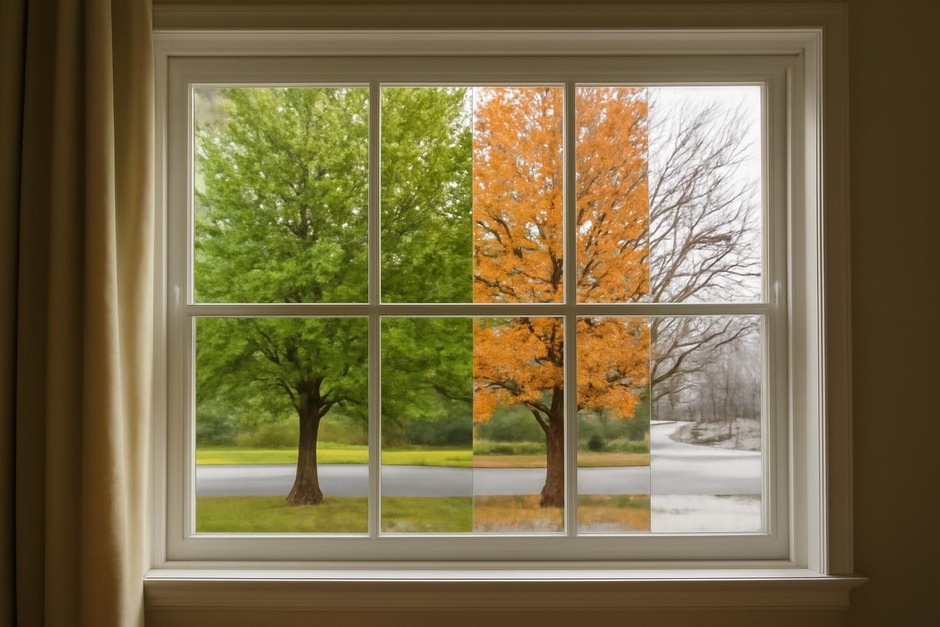
A Single-Window Practice: Six Small Experiments to Learn Seasonal Change
Learning to notice seasonal change is less about a single big discovery and more about training a small, reliable habit. The aim of these experiments is a modest one: after a few weeks you will recognize patterns—when buds appear, when leaf color shifts, when light changes at the same hour—that most people miss. Each experiment is short, repeatable, and designed to correct a common mistake that slows learning.
How to use these experiments
Choose one window that faces an outdoor scene you can return to daily: a tree, a neighbor’s garden, a stretch of sidewalk, or a patch of sky. Do one experiment at a time, for one week or a month, before moving to the next. Keep a small notebook or a simple folder for photos; consistency matters more than equipment.
Experiment 1 — The Seven-Day Same-Time Check
Goal: Notice daily light and movement by observing the same scene at the same time each day for seven days.
Common mistake
- Observing at random times and assuming you know how the scene behaves.
Correction (checklist)
- Pick a time you can consistently keep—morning coffee, lunch, or sunset.
- Stand or sit for three minutes and watch without taking photos or notes for the first minute.
- In the next two minutes, jot one sentence about light (direction, quality) and one about activity (people, cars, birds).
Experiment 2 — The One-Frame Photo Habit
Goal: Build a visual record you can compare over weeks by taking one framed photograph each day from the same spot.
Common mistake
- Taking different angles or zoom levels so comparisons become confusing.
Correction (checklist)
- Mark your camera spot with tape or a small object so the framing is consistent.
- Use the same focal length and, if possible, the same exposure mode (auto is fine).
- Store photos in a single folder labeled by week or month.
Experiment 3 — Three Sensory Details
Goal: Expand noticing beyond sight by adding sound, smell, or temperature to your notes.
Common mistake
- Focusing only on visual change and missing cues like bird arrival or damp smells that signal seasonal shift.
Correction (checklist)
- Each visit, note one sound, one smell, and one tactile cue (breeze strength, temperature at your skin).
- Record them as single words or short phrases so the habit stays easy.
Experiment 4 — Track a Single Plant or Feature
Goal: Turn diffuse noticing into a clear record by following one subject—a branch, a hedge, a planter—for a month.
Common mistake
- Trying to follow everything at once. This dilutes attention.
Correction (checklist)
- Choose one plant or fixed feature close to your window.
- Give it a short label in your notes (e.g., “Maple, north limb”).
- Each time you check, note one measurable change: bud size, number of leaves, or a visible insect.
Experiment 5 — The Weekly Composite
Goal: Build a weekly summary that shows trends more clearly than daily notes.
Common mistake
- Keeping notes without reviewing them, which prevents pattern recognition.
Correction (checklist)
- At the end of each week, spend ten minutes reviewing your seven notes and one representative photo.
- Write a single sentence answering: “What changed most this week?”
Experiment 6 — Add One Comparative Question Each Month
Goal: Deepen inquiry by asking a focused question that you answer across four weeks (e.g., “When do the first leaves turn color?”).
Common mistake
- Never narrowing attention; vague curiosity produces vague results.
Correction (checklist)
- Choose one clear question at the start of each month.
- Use your daily notes and photos to answer it at month’s end with one paragraph.
These experiments intentionally favor repetition and simplicity over novelty. The common thread is habit—returning to the same spot, the same frame, and the same short rituals. Over time the small data you collect—three-minute observations, one photo a day, a weekly sentence—turns into a sensitive map of seasonal change.
If you try them, expect small surprises: a new bird, an early thaw, a week of oddly colored light. Those modest discoveries are the point. Noticing slowly builds a steadier, more patient attention to the rhythms already present in your neighborhood and garden.