Seven Small Experiments to See and Everyday Reflections and Photograph Them
Reflections are everywhere once you start looking for them: puddles, windows, polished tables, spoons, wet leaves, even the sheen on a car. They let you rearrange a scene without moving the subjects: duplicate, invert, soften, or abstract what’s in front of you. These seven small experiments take 5–20 minutes each and build a compact skill set for noticing and using reflections in everyday photos.
How to use these experiments
Do them in order when you can; each one introduces a new idea. Use whatever camera is handy — phone, compact, or DSLR. The point is practice: short, focused tries that cultivate seeing and a couple of simple technical moves.
1. The Surface Inventory (5 minutes)
Walk a short block or around your home and list surfaces that reflect. Make a mental note of how strong the reflection is: mirror-like, soft, or a mere sheen. Try to find three kinds: a sharp mirror, a soft reflection (e.g., a wet pavement), and a diffused sheen (e.g., an oily puddle or a varnished table).
- Experiment: Photograph each surface at eye level and then at a low angle. Observe how perspective and angle change the reflection.
2. Puddle Symmetry (10 minutes)
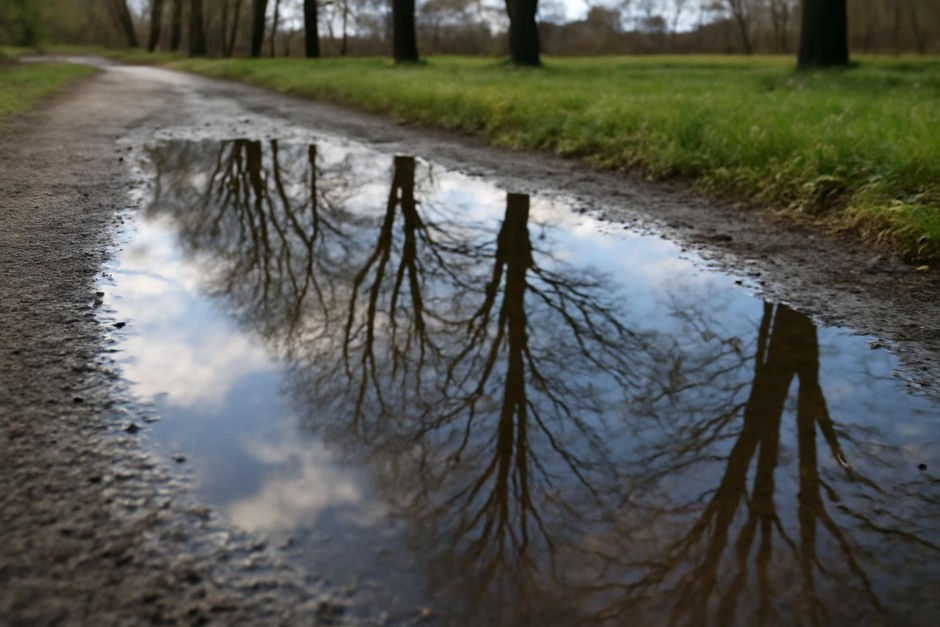
Puddles are generous teachers. At a low angle they create strong, often nearly perfect symmetry between sky and ground.
- Place your camera close to the puddle’s edge. Frame so the reflection fills half the frame or creates a vertical bisecting line.
- Try both a centered composition and an off-center composition. Notice how the reflection can simplify a scene — it removes distracting foreground elements.
3. Window Layers (10–15 minutes)
Windows give you two pictures at once: the scene outside and the interior reflected back. Hunt for places where those layers interact.
- Shoot at different distances from the glass. Close to the window, the reflection becomes more subtle; further away you increase the visible reflection.
- Use the reflection to add foreground interest or to frame a subject seen through the glass. Turn lights inside on or off to change the balance between interior and exterior.
4. Small Mirrors and Unexpected Shapes (10 minutes)
Everyday shiny objects — spoons, metal signs, the hood of a car — bend and fragment reflections into abstract shapes.
- Pick one object and move around it. Watch how the reflected scene stretches and compresses.
- Try a tight crop that turns the reflection into a pattern rather than a literal scene. This trains you to read texture and form.
5. Polarizer Test (if available, 10 minutes)
If you have a polarizing filter or a phone with a polarization app, use it to see what changes. Polarizers cut glare and can either suppress or enhance reflections depending on the angle.
- Shoot the same scene with and without the polarizer. Note when the reflection disappears and when colors deepen. This teaches you that reflections carry both light and information.
6. Motion and Reflection: Streams and Cars (15–20 minutes)
Introduce movement. Fast-moving water softens reflections into streaks; a passing car distorts mirrored rows.
- Try a slightly longer exposure for water (0.5–1 second handheld or longer on a tripod) to see how the reflection blurs into a painterly streak.
- Photograph a row of parked cars and wait for a car to pass by. The momentary disturbance in reflections often yields surprising shapes.
7. Micro-Reflections: Droplets and Leaves (10–15 minutes)
Very small reflective bodies reverse the scale: a single water drop can hold a tiny, inverted scene. This is the exercise that asks you to slow down and look very close.
- Use a close-focus mode or a macro lens/phone macro attachment. Focus on a droplet at the edge of a leaf or a tiny puddle in a bowl.
- Experiment with backlighting to make the droplet glow, or side-lighting to reveal its shape and the tiny inverted image inside.
Concluding practice
After these experiments, pick one reflection type that felt most interesting and repeat it three times on different days or in different weather. The repeated act of looking — at puddles, windows, shiny objects — is the skill: you learn where reflections hide, how light alters them, and how to compose with them so they become a deliberate element rather than a curiosity.
Reflection work rewards patience. It teaches you to see the same place twice, to build subtle layers, and to notice how a small change of angle or light makes a new picture. Keep each experiment short and focused, and let the small discoveries accumulate.